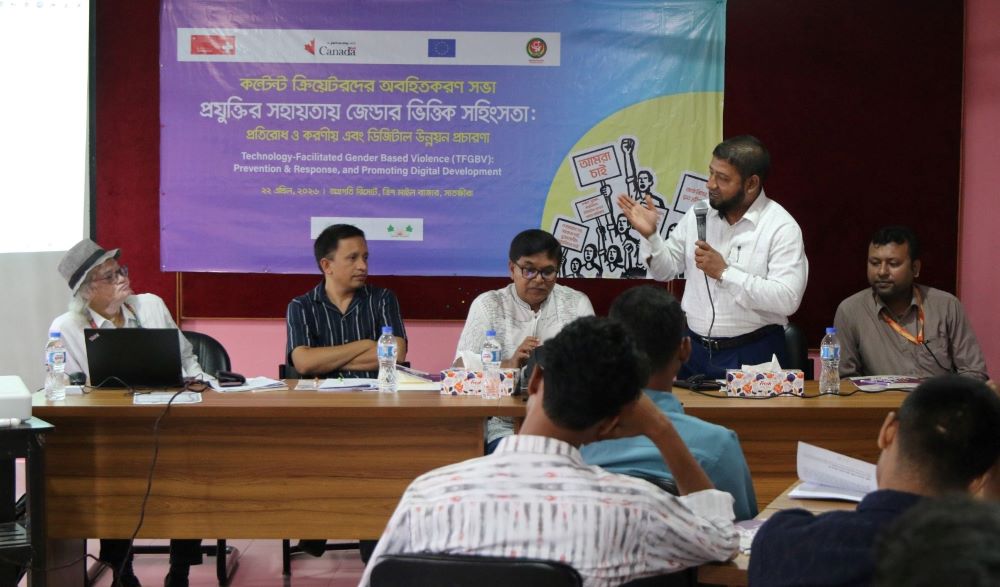
In this era of digital transformation, Technology-Facilitated Gender-Based Violence-TFGBV has emerged as a growing social and human rights concern. Women and girls, in particular, face heightened risks of such violence, making awareness raising, preventive action and effective coordination more urgent than ever.
Against this backdrop, Bangladesh NGOs Network for Radio and Communication-BNNRC, in collaboration with Agrogoti Sangstha, organized an awareness and orientation meeting on 22 April 2026 titled: ‘The Role of Local Content Creators and YouTubers in Preventing and Mitigating TFGBV and Promoting Digital Movement.’ The event brought together 32 local YouTubers and content creators, combining 1.2 Million Viewers.
The objective of the meeting was to enhance participants’ understanding of TFGBV and response mechanisms, while encouraging them to produce content on the issue and use their platforms to promote awareness and prevention messages.
The event was graced by Mohammad Jaharul Islam, District Information Officer, Satkhira as the Chief Guest.
The meeting was organized under BNNRC’s project, ‘Strengthening Resilience against Technology-Facilitated Gender-Based Violence and Promoting Digital Development,’ implemented under the Nagorikata: Civic Engagement Fund-CEF program, supported by Switzerland, Global Affairs Canada and the European Union, with technical assistance from GFA Consulting Group.
Abdus Sabur Biswas, Executive Director of Agrogoti Sangstha, emphasized that content creators should not limit themselves to entertainment alone but act as agents of social change and development. He urged participants to avoid spreading false or misleading information online and encouraged them to create visionary, impactful content that leaves a positive legacy.
AHM Bazlur Rahman, Chief Executive Officer of BNNRC, described content creators as ‘Digital Development Workers’ in today’s society. He noted that awareness alone cannot address TFGBV; rather, the crisis demands coordinated, multidimensional actions.
Md Nurul Islam, Capacity Development and Management Expert, Nagorikata CEF, said that content creators now act as mirrors of society, influencing audiences of all ages. He urged participants to ensure that entertainment content does not unintentionally reinforce harmful messages or gender discrimination.
Popular Satkhira-based content creator Yasin Arafat stressed the need for more constructive, positive content and called for solidarity among creators to discourage harmful or negative content through collective social accountability.
Participants also shared recommendations, noting that trolling and abusive comments often discourage meaningful creative work. They emphasized the need for unity among creators, regardless of scale and proposed regular, government-supported workshops that engage both creators and parents.
The session included discussions on strategies for producing safe, gender-sensitive and inclusive content, along with orientations on Facebook and YouTube community guidelines and ethical standards for digital behavior.
Speakers highlighted the importance of public awareness on digital development and TFGBV and shared information on government initiatives and support services, including Police Cyber Support for Women (Helpline: 01320-000888; Email: cybersupport.women@police.gov.bd).
As Special Guest, Shariful Islam, District ICT Officer, informed that he will propose to co-opt two to three content creators into the district ICT committee and recommend their participation in monthly coordination meetings through the Deputy Commissioner’s office. He also encouraged participants to obtain freelancer ID cards from the ICT Ministry.
In his closing remarks, Chief Guest Mohammad Jaharul Islam stated that content creators are a highly influential force in digital society. He urged them not to pursue cheap or short-lived popularity, but rather to use their talent, creativity and social reach to contribute to positive change in Satkhira and across Bangladesh.
At the end of the meeting, participants received certificates and were provided with a draft ethical guideline for content creators developed by BNNRC. They pledged to use their platforms to promote digital development and create awareness-building content to prevent TFGBV, contributing to a safer digital environment for women and girls. Press Release