In the era of rapid digital transformation, technology-facilitated gender-based violence-TFGBV has emerged as a growing social and human rights concern. Women and girls are disproportionately at risk, underscoring the urgent need for heightened awareness, effective prevention strategies and coordinated action.
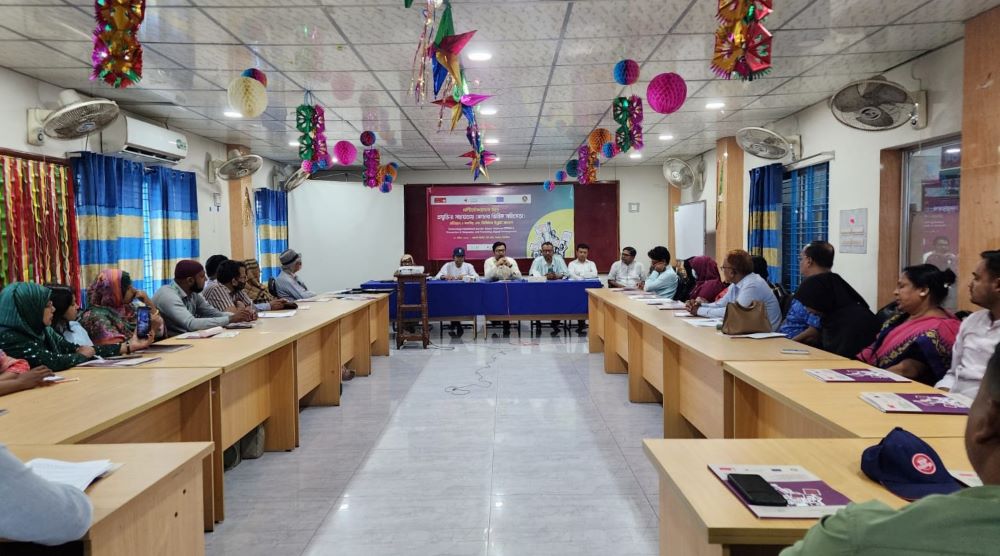
Against this backdrop, the Bangladesh NGOs Network for Radio and Communication-BNNRC, in collaboration with Agrogoti Sangstha, organized a multi-stakeholder dialogue in Satkhira on 20 April. The dialogue brought diverse stakeholders to discuss digital development, the nature and forms of TFGBV, its societal impacts and strategies for prevention and mitigation.
The event was graced by Md Sharif Asif Rahman, Additional Deputy Commissioner of Satkhira, as the Chief Guest. The dialogue was held as part of the project titled ‘Strengthening Resilience against Technology-Facilitated Gender-Based Violence and Promoting Digital Development.’ The project is being implemented under the Nagorikata: Civic Engagement Fund-CEF programme, with technical support from GFA Consulting Group and funding from Switzerland, Global Affairs Canada and the European Union.
At the outset, Abdus Sabur, Executive Director of Agrogoti Sangstha, delivered the welcome remarks. He highlighted that incidents of technology-facilitated violence often remain concealed within families and communities, particularly in cases involving women. He emphasized the importance of breaking this silence and bringing the issue into public discourse through collective efforts.
AHM Bazlur Rahman, Chief Executive Officer of BNNRC, delivered a comprehensive presentation outlining the concept, forms, adverse impacts, and preventive measures related to TFGBV. He stressed that ensuring safe and inclusive digital development requires a collective response involving families, educational institutions, media, civil society and public administration to prevent the misuse of technology.
The dialogue featured interventions from four designated discussants, followed by an open discussion session with participants. Contributors emphasized the need to strengthen grassroots awareness, enhance institutional accountability and engage new stakeholders in prevention efforts. In particular, the inclusion of internet service providers, cable network representatives and local agents of mobile financial services was identified as critical to a more holistic response.
Esmat Ara, Assistant Director of the Department of Youth Development, noted that while technology creates new opportunities, its unregulated use also introduces new risks. She emphasized that building awareness at all levels of society can significantly reduce technology-facilitated violence.
In his remarks, the Chief Guest, Md Sharif Asif Rahman, observed that the expansion of digital platforms has transformed the nature of gender-based violence. He underscored the importance of fostering tolerance, mutual respect, the free flow of accurate information and strong family values in addressing these challenges. He further stressed that the principles of equality, dignity and safe coexistence between women and men must be nurtured from an early age within families.
He added that while development without technology is no longer feasible, ensuring its responsible and ethical use is imperative. Combating misinformation and disinformation, enhancing digital safety awareness and promoting coordinated social action can help build a safe and inclusive society. He also assured full administrative support for such initiatives.
Speakers and Guests also highlighted the Bangladesh Police’s ‘Police Cyber Support for Women’ service. Women and girls experiencing cyber violence can seek assistance by calling 01320000888 or by emailing cybersupport.women@police.gov.bd. Press Release