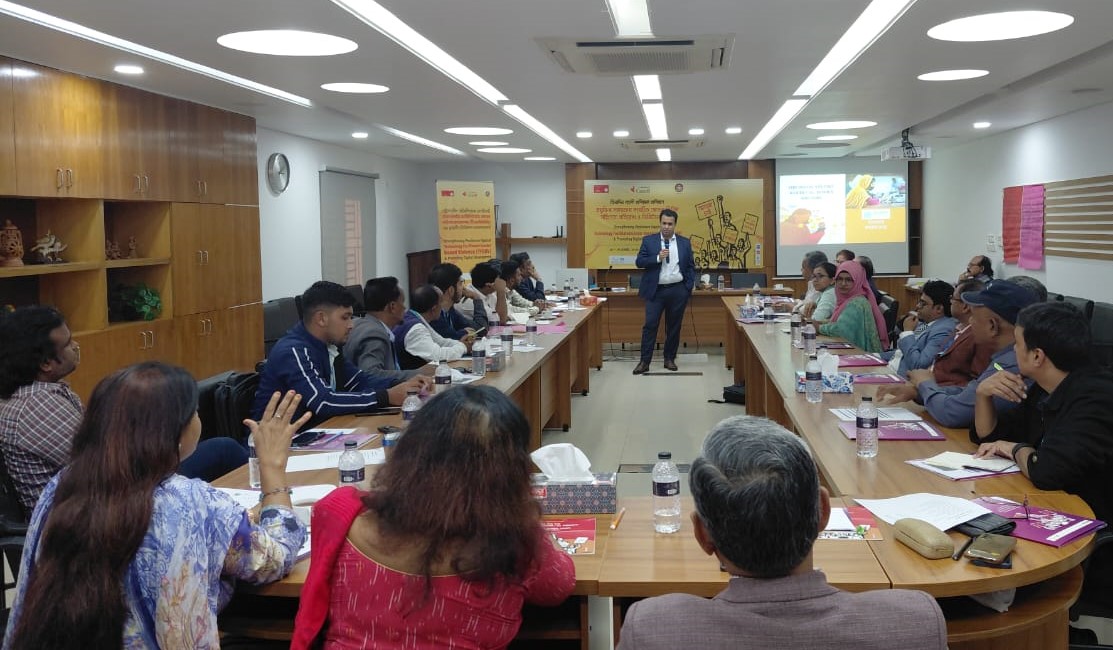
The Bangladesh NGOs Network for Radio and Communication-BNNRC organized a three-day Training of Trainers on the prevention, mitigation and response to Technology-Facilitated Gender-Based Violence-TFGBV and promoting Digital Development.
A total of 26 journalists, local NGO and CSO representatives, lawyers and human rights activists from various districts, including Dhaka, Pirojpur, Barishal, Patuakhali, Mymensingh, Satkhira and Kushtia participated in training.
The opening remarks and purpose of the training were presented by the course coordinator, Rehan Uddin Ahmed Raju. He explained the training’s goal, stating that the aim was to build a team of 25 skilled trainers in TFGBV and promote digital development. The training focused on enhancing the capacity of journalists, local NGOs, CSOs, professionals and human rights workers to actively participate in advocacy and awareness-raising activities. Additionally, the training aimed to empower the trainers to conduct mentoring, consultation and capacity-building workshops at the local level. He also highlighted the importance of topics such as training, workshop management, lobbying, public hearings, stakeholder identification, the constitutional framework of Bangladesh and legal measures, including the Nari o Shishu Nirjatan Protirodh Ain and the Cybersecurity Ordinance 2025.
BNNRC is implementing the project Strengthening Resilience Against Technology-Facilitated Gender-Based Violence-TFGBV & Promoting Digital Development, the project is part of the Nagorikata : Civic Engagement Fund-CEF programme. It is implemented with technical support from GFA Consulting Group and funded by Switzerland and Global Affairs Canada.
BNNRC’s CEO, AHM Bazlur Rahman delivered a detailed discussion on TFGBV : its concept, types, negative impacts, digital development, desired outcomes and responsibilities. In his presentation, he discussed the Fourth Industrial Revolution, digital development, UN Summit on the Information Society-WSIS, digital security, and the role of local civil society organizations, NGOs, and journalists in preventing TFGBV through digital tools. He further emphasized preparing new areas of work and identifying stakeholders for this cause.
Abu Sayed Suman, National Programme Officer of UNFPA, discussed the concept of technology-facilitated gender-based violence, its prevention and mitigation. He elaborated on UNFPA’s initiatives and on how they approach TFGBV prevention, as well as on the country’s related legal frameworks and government initiatives.
On the second day, Nurul Islam, Capacity Development Expert from GFA and Nagorikata, Civic Engagement Program, joined the opening session to discuss the purpose and expected outcomes of the training with the participants. He highlighted how participants could expand their efforts to address these issues more broadly in their respective fields and communities.
Hiren Pandit, Project Coordinator of BNNRC, presented a session on Information Integrity, focusing on the fundamentals of misinformation, disinformation and Mal-information, their consequences and how to counteract them.
Sadia Tasneem, Consultant at UN Women, discussed the international and national initiatives to address TFGBV and the role of UN Women in shaping legal frameworks and government efforts to combat it.
The participants gained valuable knowledge and skills to increase accountability and foster positive changes in the prevention, mitigation, and response to TFGBV, as well as digital development. They were encouraged to work on local-level advocacy to ensure the involvement of relevant stakeholders in TFGBV prevention and mitigation. The session concluded with a practice session on facilitation skills, followed by training evaluations and the distribution of certificates.