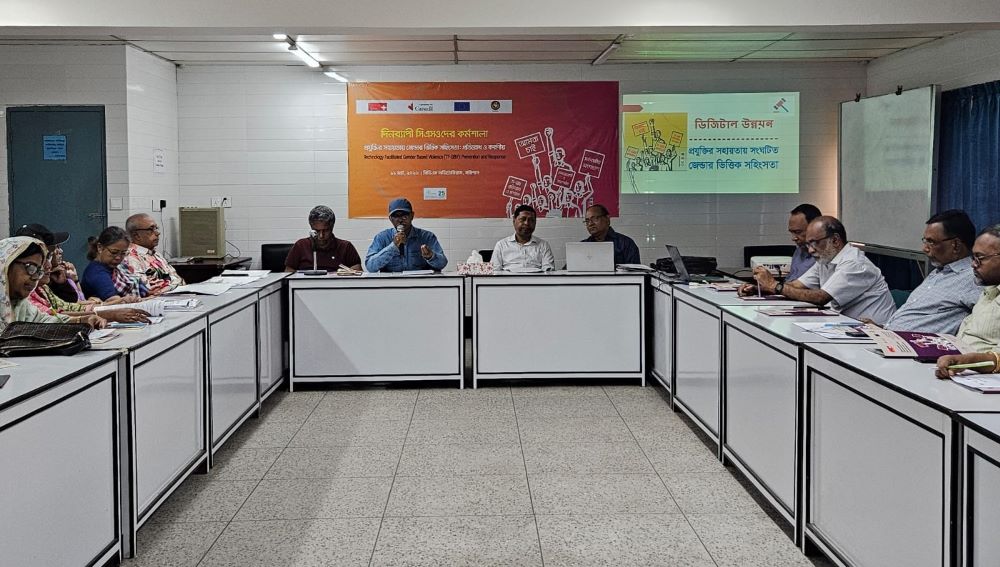
The Bangladesh NGOs Network for Radio and Communication-BNNRC organized a day-long capacity-building workshop titled ‘Digital Development and Addressing Technology-Facilitated Gender-Based Violence-TFGBV : Prevention, Mitigation, and Response for Civil Society Organizations.’
The workshop was held at the BDS Conference Hall in Barishal on Wednesday (March 11) and brought together representatives from civil society organizations-CSOs, NGOs, women’s organizations and women-led organizations.
The workshop was chaired by AHM Shamsul Islam Dipu, Mission Head of Speed Trust, Barishal, while Subhankar Chakraborty, Executive Director of MAP Barishal, Resource Team Member of BNNRC and a TFGBV trainer, served as the moderator.
In his presentation, Subhankar Chakraborty delivered the keynote paper highlighting the nature, forms and impacts of TFGBV in the context of rapid digital transformation.
The event was graced by Md Mojammel Hossain as the Chief Guest. It is worth mentioning that BNNRC organized the workshop under the project titled ‘Strengthening Resilience against Technology-Facilitated Gender-Based Violence-TFGBV and Promoting Digital Development.’ The project is implemented as part of the ‘Nagorikata: Civic Engagement Fund-CEF” programme, funded by the Government of Switzerland, Global Affairs Canada and the European Union, with technical assistance from GFA Consulting Group.
The workshop featured four panel speakers and twelve designated speakers, who contributed to thematic discussions on digital development and the prevention of TFGBV. In his welcome remarks, AHM Shamsul Islam Dipu outlined the objectives and expected outcomes of the workshop. The primary aim was to enhance the capacity of CSO representatives to play informed, responsible roles in addressing digital development challenges and combating TFGBV, while also encouraging them to integrate these issues into their organizational programmes and activities.
Speakers emphasized that while Bangladesh is undergoing rapid digital transformation, the misuse of technology is also on the rise. According to the UNFPA Report (2024), 89 percent of women and girls in Bangladesh experience some form of technology-facilitated violence, yet 75 percent of the victims do not seek legal remedies. In this context, participants stressed that active engagement of civil society organizations and sustained public awareness initiatives are crucial to addressing this growing challenge.
The workshop also included practical sessions on digital safety and security, such as using strong passwords and two-factor authentication for Facebook and email accounts, methods for reporting abusive or harmful online content and information on existing laws and legal support mechanisms to address technology-facilitated violence. Speakers highlighted the importance of public awareness of digital development and TFGBV and shared information about government initiatives, including the Police Cyber Support for Women Helpline (01320-000888) and the email support service (cybersupport.women@police.gov.bd).
In his address, Chief Guest Md Mojammel Hossain stated,
“Violence against women through the misuse of technology is increasing at an alarming rate. Preventing this requires collective efforts from all sectors. Since girls between the ages of 8 and 14 are often the first victims of TFGBV, raising awareness among parents about the responsible use of digital technologies can play a significant role in preventing such violence.”
During the ‘Deep Dive’ session, participants discussed various district-level challenges related to TFGBV and explored potential solutions and collaborative actions. The session was facilitated by Pankaj Roy Chowdhury, Resource Team Member of BNNRC and a TFGBV Trainer.
At the end of the workshop, participants expressed their commitment to actively working in their respective communities to prevent and mitigate TFGBV and to support survivors in accessing appropriate services and assistance. The organizers expressed optimism that such initiatives would help curb the misuse of technology at the local level and contribute to building a safer and more inclusive digital environment for women and girls. Press Release