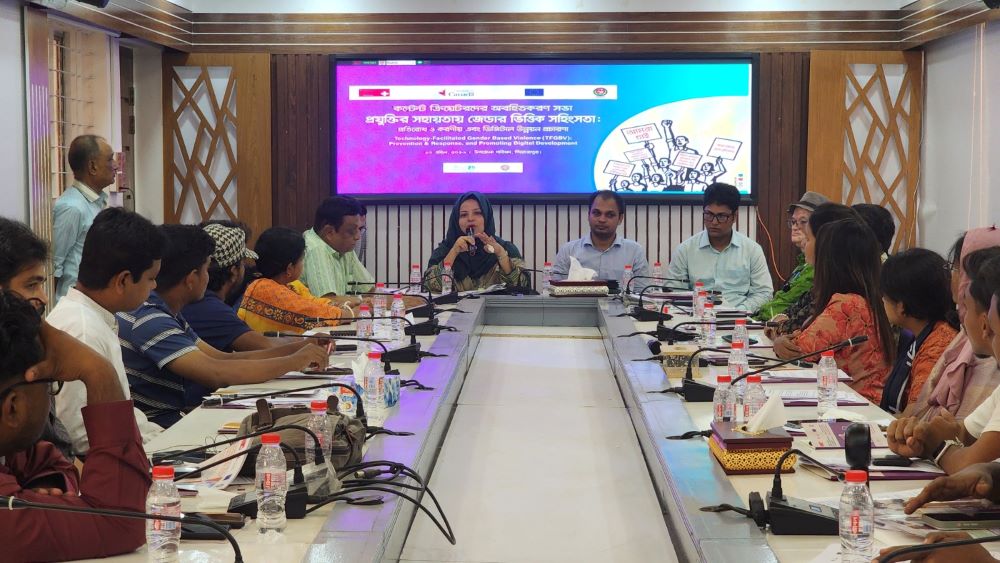
In this era of digital transformation, Technology-Facilitated Gender-Based Violence-TFGBV has emerged as a growing social and human rights concern. Women and girls in particular remain disproportionately vulnerable to such violence, making awareness raising, preventive action and effective coordination an urgent necessity.
Against this backdrop, Bangladesh NGOs Network for Radio and Communication-BNNRC and Pirojpur Gano Unnayan Samity organized an orientation today, 23 April 2026, on ‘The Role of Local Content Creators in Preventing and Mitigating TTFGBV and Promoting Digital Development.’ The meeting brought together 30 local content creators from Pirojpur, whose combined follower base exceeds 2.6 million.
The objective of the awareness meeting was to enhance local content creators’ understanding of TFGBV and responses to address it, while encouraging them to produce content on the issue. Participants were motivated to use their digital platforms to spread messages that raise public awareness and help combat TFGBV.
The chief guest of the event was Tanzila Kabir Tropa, Additional Deputy Commissioner and Additional District Magistrate. The orientation was organized under BNNRC’s project, ‘Strengthening Resilience against Technology-Facilitated Gender-Based Violence and Promoting Digital Development.’ The project is part of the NAGORIKATA: Civic Engagement Fund-CEF programme, funded by Switzerland, Global Affairs Canada and the European Union, with technical support from GFA Consulting Group.
Speaking at the event, Ziaul Ahsan, Executive Director of Pirojpur Gano Unnayan Samity said that there is currently no specific regulatory framework for content creators, which often makes accountability challenging. He expressed hope that the recently passed Cyber Security Act would pave the way for the development of clear guidelines and regulations for content creators.
AHM Bazlur Rahman, Chief Executive Officer of BNNRC, noted that since the launch of Bangladesh’s ICT Policy in 2001, the country has made significant progress in digital development over the past 25 years. However, he emphasized that 44 percent of the population still does not use the internet and this digital divide continues to hinder inclusive development.
Md Nurul Islam, Capacity Development and Management Expert at NAGORIKATA: Civic Engagement Fund-CEF, urged content creators to produce content that promotes dignity and respect for all people, regardless of gender, ethnicity, religion, indigenous identity, or age.
The orientation included in-depth discussions on strategies for creating safe, gender-sensitive and inclusive content, as well as on the ethical standards of digital behavior, including the Facebook and YouTube community guidelines.
Speakers stressed the importance of raising public awareness on digital development and TFGBV and discussed government initiatives and support services, including Police Cyber Support for Women (Helpline: 01320000888, Email: cybersupport.women@police.gov.bd).
Special Guest Al Amin, Acting Upazila Nirbahi Officer of Pirojpur Sadar, encouraged creators producing entertainment and vlog content to incorporate messages on cybercrime, financial fraud and gender-based violence into their work, noting that even small efforts can contribute to building a safer and more livable society.
Participants also highlighted that many victims of online harassment or injustice do not know where to seek help or lodge complaints, while others remain silent due to shame or lack of confidence. They emphasized the need to raise awareness about pathways to justice and support survivors in seeking redress.
Special Guest Saifuddin Al Madani, Assistant Director of the District Information Office, stated that violence is not limited to violence against women; degrading portrayals of men in content should also be considered harmful. He noted that some so-called ‘funny content’ normalizes disrespect and sends negative social messages, urging creators to reflect on the social impact of their content before publishing.
Special Guest Abul Hasan, District ICT Officer, emphasized that maintaining information integrity is crucial for responsible content creation. He stressed that creators have a duty to verify the truthfulness, objectivity and ethical dimensions of content before publishing. Recognizing the creative profession and cybersecurity concerns of content creators, he expressed commitment to advocating for their inclusion in upazila-level ICT and cybercrime prevention committees. He also assured support from his office in facilitating access to Freelancing Cards, acknowledging content creators’ contributions as ‘remittance warriors’ through foreign currency earnings.
Chief Guest Tanzila Kabir Tropa highlighted the importance of understanding the extent of online harassment faced by women content creators and identifying perpetrators to ensure appropriate action. She emphasized that the same respect shown to women within families should be extended to all women in society.
At the conclusion of the orientation, all participating content creators received certificates and a draft Code of Ethics for Content Creators developed by BNNRC. They pledged to use their platforms to promote digital development and produce awareness-building content to prevent TFGBV, contributing to a safer digital environment for women. Press Release