In the era of digital transformation, Technology-Facilitated Gender-Based Violence-TFGBV has emerged as a growing concern, disproportionately affecting women and girls. According to data from the UNFPA, globally, two out of every three women experience some form of technology-facilitated gender-based violence and in Bangladesh, the rate is as high as 89%.
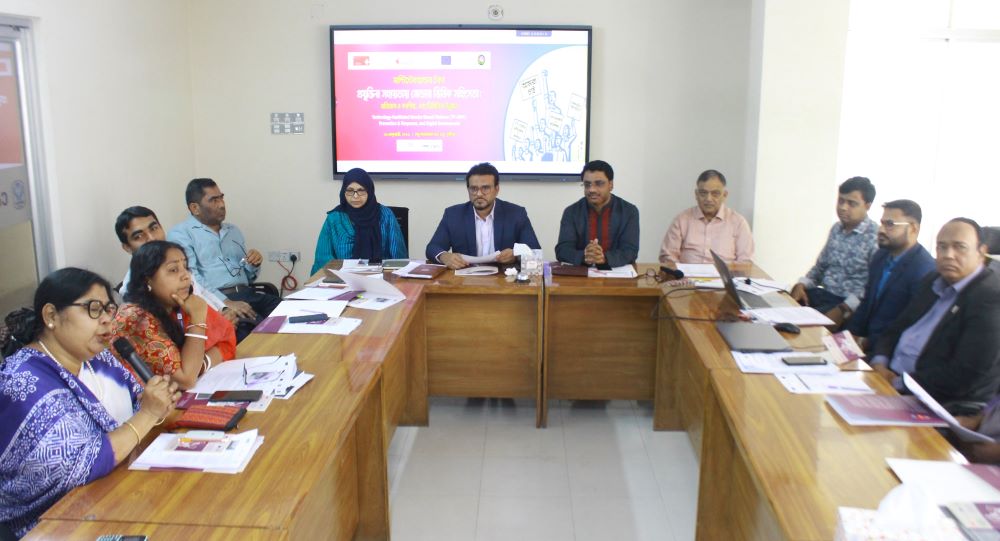
To address this alarming situation, Bangladesh NGOs Network for Radio and Communication-BNNRC and SETU jointly organised a multi-stakeholder dialogue in Kushtia on Monday (23 February). The dialogue focused on digital development and strategies for preventing and mitigating Technology-Facilitated Gender-Based Violence.
The event was graced by the Additional Deputy Commissioner (Education & ICT, Development & Human Resource Management) of Kushtia District, Md Mizanur Rahman, as the Chief Guest. The dialogue was organised under the project titled “Strengthening Resilience Against Technology-Facilitated Gender-Based Violence-TFGBV and Promoting Digital Development”, implemented under the Nagorikata: Civic Engagement Fund-CEF programme. The GFA Consulting Group is providing technical support and is funded by Switzerland, Global Affairs Canada, and the European Union.
The primary objective of the dialogue was to provide participants with a comprehensive understanding of the forms, impacts and prevention mechanisms of TFGBV, as well as to raise awareness about relevant laws and policies. Participants were encouraged to strengthen knowledge, accountability and institutional initiatives to prevent technology-facilitated violence and to take more effective action toward digital development and safety.
Dr Md Abdul Quader, Executive Director of SETU, delivered the welcome remarks and outlined the objectives and expected outcomes of the programme.
Hiren Pandit, Programme Coordinator of BNNRC, presented an in-depth discussion on the concepts, types, negative impacts and responsibilities related to Technology-Facilitated Gender-Based Violence and digital development. He also highlighted various statistics demonstrating the severity and prevalence of TFGBV.
The dialogue featured 12 designated speakers, followed by an open discussion session moderated by Dr Md. Abdul Quader. Participants expressed their commitment to organising awareness activities on the types, prevention, mitigation, and necessary actions regarding TFGBV. They also emphasised the importance of engaging new stakeholders—such as Internet Service Providers-ISPs, cable network representatives and mobile financial service agents, including bKash and Rocket—to enhance awareness and coordinated action.
Special guests underscored the importance of raising public awareness on digital development and TFGBV. They highlighted the Government’s initiative, the Police Cyber Support for Women helpline (01320000888) and email (cybersupport.women@police.gov.bd), as critical support mechanisms. They emphasised that awareness and collective responsibility are essential to building a safe and inclusive society.
Dr Dhananjay Kumar, Professor, Department of Management, Islamic University, stated that while technology brings numerous benefits, misuse largely stems from a lack of awareness. He stressed that fostering social awareness at all levels can significantly reduce technology-facilitated gender-based violence.
Dr Paresh Chandra Barman, Professor, ICT Department, Islamic University, remarked that technology cannot be stopped; instead, its responsible use must be ensured. He expressed concern that excessive, unregulated exposure to social media is negatively affecting children’s emotional development. He emphasised the critical role of families in guiding children’s responsible use of technology and social media.
Dr Md Rasheduzzaman, Chairman, Department of Communication and Multimedia Journalism, noted that adolescents today are exposed to adult gender-related content before developing an appropriate understanding, due to unregulated digital access. He highlighted the need for parents, educators, NGOs, media professionals and civil society to take shared responsibility in preventing technology-facilitated violence. He called upon everyone to become “a lamp” spreading awareness throughout society.
Ms Nargis Sultana from the Department of Women Affairs, Kushtia, stated that while her department works on women’s empowerment, violence prevention and child marriage prevention at the grassroots level, TFGBV has now emerged as a significant concern. She pledged to incorporate TFGBV awareness into community courtyard meetings and emphasised the need for stricter parental supervision of children’s mobile phone usage.
In his closing remarks, Chief Guest Md Mizanur Rahman emphasised the importance of nurturing values within families. He stated that educating families about responsible mobile phone use and integrating civic sense and ICT ethics into the education system are crucial steps in reducing technology-facilitated violence. He further stressed the need to curb misinformation and disinformation and ensure the flow of accurate information to uphold truth and social harmony.
Acknowledging that technology is indispensable for progress, he called upon families, schools, media, NGOs and the administration to work collectively to address the growing challenge of technology-facilitated violence. He assured us full administrative support for such initiatives. Press Release